Rapid Small-Scale Column Testing, Ion Exchange Resin Test Data
Repeatable PFAS results that let you screen candidate IX resins on your utility’s water
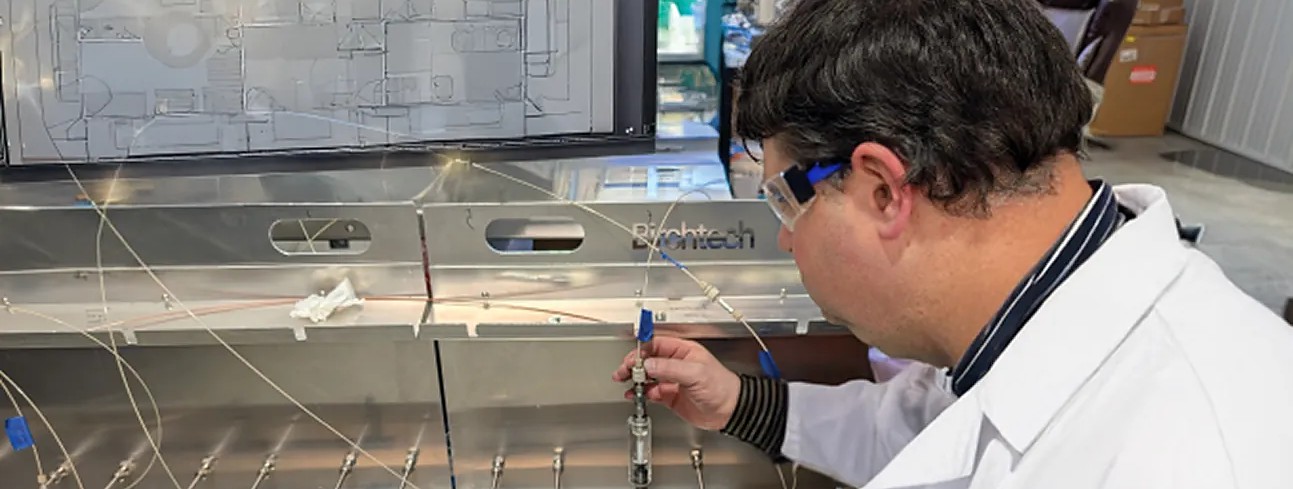
Resin performance depends on your water. Birchtech’s Analytical Design Center shows how candidate resins behave on it, with repeatable results, in days, before you commit to a pilot.
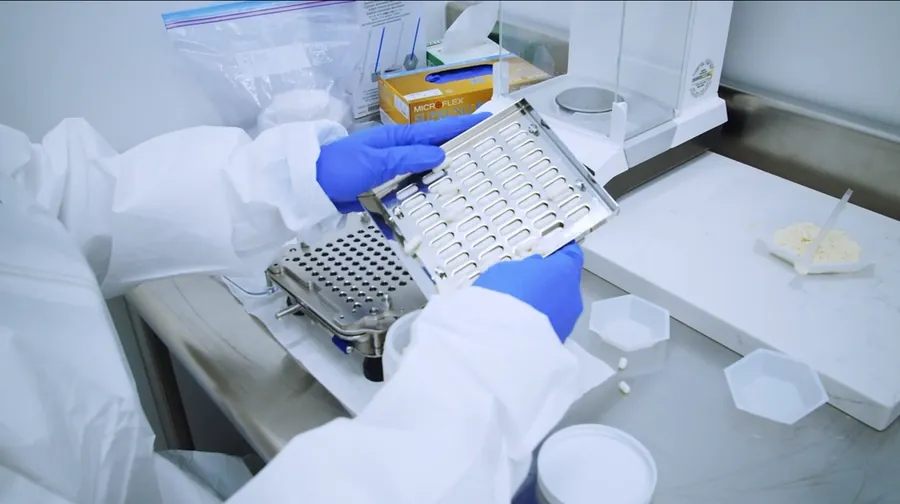
Rapid small-scale column testing (RSSCT) runs your water through a scaled-down column of finely ground media. The conditions are set to mimic a full-scale vessel, so the results help predict how the full-size bed will behave. We tested our system on ion exchange (IX) resin breakthrough.
What we tested
Three IX resins were run in duplicate on the same water. One resin was repeated a week later on a separate run. In every test, PFOA was the PFAS contaminant measured in the water.
| Test condition | Detail |
|---|---|
| Method | RSSCT, constant-diffusivity conditions |
| Media preparation | IX resin ground to 170x200 U.S. mesh |
| Contaminant | PFOA, spiked at approximately 50 ppt |
| Water | Sample water from the Midwest US |
| Throughput | 30,000 bed volumes |
| Contact time (EBCT) | IX resin 1.97 min |
| Replication | Duplicate columns on one run; repeat run one week later |
| Analysis | LC-MS |
The water. Sample water from the Midwest US, spiked with PFOA at approximately 50 ppt. Water quality: total organic carbon (TOC) 6.60 mg/L, total alkalinity 63.3 mg/L and UV254 absorbance 0.093 cm−1.
- Run 1, column 1
- Run 1, column 2
- Run 2 (one week later)
What we found
- Repeatable results. Duplicate columns agreed closely, and the repeat run matched the original two columns. PFOA breakthrough curves from separate runs were consistent (Figure 1).
- Different resins showed clearly different PFOA breakthrough performance on the same water, so the test can distinguish between resins (Figure 2).
- Resin A (PFAS-designed), col. 1
- Resin A (PFAS-designed), col. 2
- Resin B (inorganic-designed), col. 1
- Resin B (inorganic-designed), col. 2
- Resin C (inorganic-designed), col. 1
- Resin C (inorganic-designed), col. 2
What our capabilities mean for you
| Capability | What it means for you |
|---|---|
| Six independently operated columns | A test is configured around your parameters, such as which resins to compare or which contact times to test, instead of running under one fixed condition. |
| Capability to compare media in one study | The system has the capability to compare multiple candidate resins on your water, in the same study. |
| Continuous, automated sampling | Samples are taken around the clock at set bed-volume intervals, so data points land consistently across the run to better determine the breakthrough points. |
| In-house LC-MS analysis | Analysis sits in the same facility as the columns, which keeps the workflow in one place. |
| Repeatable results | Duplicate columns and a repeat run a week later agreed closely in our test, giving you confidence that differences between resins are real. |
| Pilot preparation | Testing on your water can help identify potential issues, such as bed blinding or particulate build-up, before pilot testing, and help screen candidate media. |
What you receive
A report with the influent water description, media tested with manufacturer, the empty bed contact time, sampling and analytical methods, the breakthrough curves, and other data as needed for different projects.
Compare media on your water.